







The Largest Religious Monument on Earth
Angkor Wat is a 12th-century Hindu temple complex (later converted to Buddhism) covering approximately 162.6 hectares in the Angkor Archaeological Park near Siem Reap, Cambodia. It is the largest religious monument ever constructed — a symmetrical arrangement of towers, galleries, courtyards, and moats built by King Suryavarman II between approximately 1113 and 1150 AD as the state temple of the Khmer Empire. The central tower rises 65 metres above the surrounding plain, and the entire complex is enclosed by a 190-metre-wide moat that stretches 5.5 kilometres in circumference.
The temple’s significance extends beyond its scale. The bas-reliefs lining the gallery walls (extending approximately 800 metres in total length) depict scenes from Hindu mythology (the Churning of the Ocean of Milk, the Battle of Kurukshetra from the Mahabharata) and historical narratives (Suryavarman II’s army on the march, including identifiable Khmer and Cham soldiers and war elephants). The architectural precision — the temple is oriented to the west (unusual for Hindu temples, which typically face east), aligned with the spring equinox sunrise, and designed with astronomical and cosmological symbolism — reflects a civilisation of extraordinary technical and intellectual sophistication.
Angkor Wat is the centrepiece of the Angkor Archaeological Park, which contains the remains of the various capitals of the Khmer Empire from the 9th to 15th centuries, and the single most-visited attraction in Cambodia (approximately 2.5 million visitors annually).
How to Visit
The Angkor Pass is required for all visitors to the Angkor Archaeological Park. The pass is purchased at the official ticket office on the Apsara Authority Road (not at the temples themselves). One-day passes, three-day passes (usable over any 10 consecutive days), and seven-day passes (usable over any month) are available. Bring your passport — the ticket includes a photograph taken at the office.
A guided tour is strongly recommended. Angkor Wat’s religious symbolism, its astronomical alignments, its historical context within the Khmer Empire, and the meaning of its bas-reliefs are not self-evident. Without a guide, you see beautiful stone architecture. With a guide, you understand a civilisation.
The standard Angkor circuit visits Angkor Wat, Angkor Thom (the walled city containing the Bayon temple), and Ta Prohm in a single day — the “small circuit” that covers the three most significant temples. This is the minimum visit. A second day adds the outer temples (Banteay Srei, Beng Mealea, Pre Rup, and others).
Practical Tips
Dress modestly. Shoulders and knees must be covered to enter the central tower of Angkor Wat and other temple interiors. This is strictly enforced. Bring a scarf or light cover-up.
Bring water and sun protection. The temple complex is vast and largely exposed. Siem Reap temperatures regularly reach 35°C+ with high humidity. Dehydration is the most common visitor health issue. Carry at least 2 litres of water.
Visit the central tower in the early morning or late afternoon. The queues for the steep staircase to the upper level (where the central tower and the finest bas-reliefs are located) build from mid-morning. Early arrival or late-afternoon timing reduces the wait and the heat.
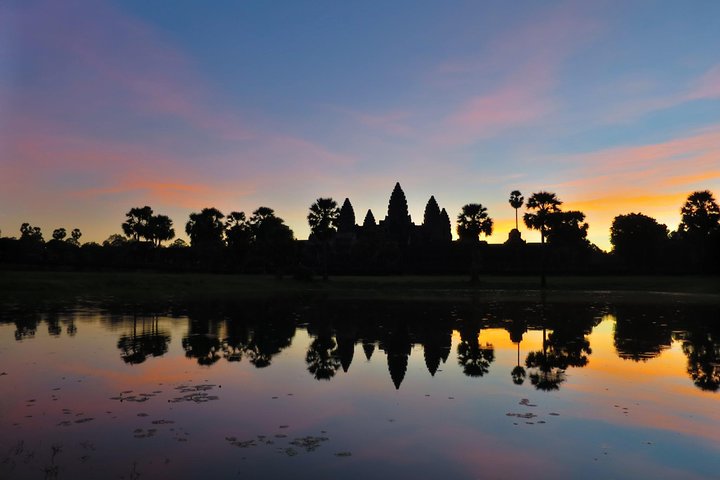
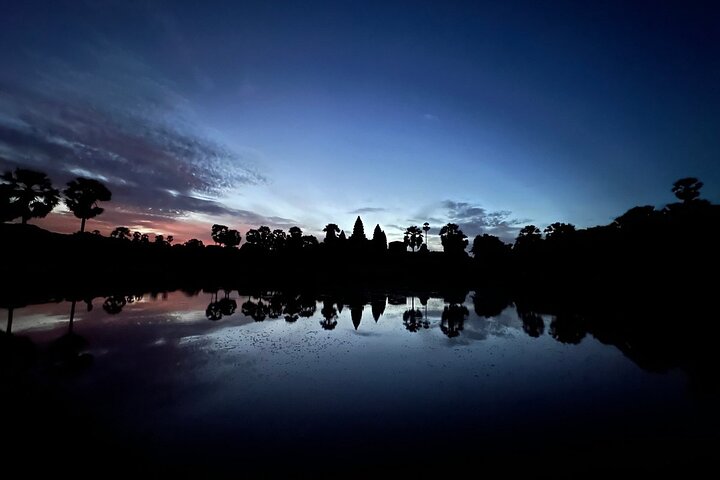
The moat and the western entrance create the classic photograph. The reflection of the five towers in the moat water, framed by the causeway, is the defining image of Angkor Wat and one of the most photographed scenes in Southeast Asia. The reflection is best in the still water of early morning.
Frequently Asked Questions
How long should I spend at Angkor Wat?
A thorough visit takes 2–3 hours for the temple itself (the galleries, the bas-reliefs, the central tower climb, the outer courtyards). The full small-circuit day (Angkor Wat, Angkor Thom/Bayon, Ta Prohm) takes 8–10 hours.
How much is the Angkor Pass?
One-day pass: $37 USD. Three-day pass: $62 USD. Seven-day pass: $72 USD. The pass covers all temples in the Angkor Archaeological Park. Children under 12 enter free.
Is Angkor Wat a Hindu or Buddhist temple?
It was built as a Hindu temple (dedicated to Vishnu) in the 12th century and converted to Theravada Buddhism in the late 13th or early 14th century. Buddhist elements (statues, carvings) were added to the existing Hindu architecture. It functions today as a Buddhist site.
When is the best time to visit Angkor Wat?
November through February — the cool, dry season with temperatures of 25–30°C and lower humidity. March through May is intensely hot (35–40°C). June through October is the wet season (afternoon rain, lush green landscape, fewer tourists, dramatic skies).
Can I visit Angkor Wat independently?
Yes — with an Angkor Pass and your own transport (tuk-tuk, bicycle, motorbike, or car). However, a guide adds the historical and cultural narration that transforms the visit. The temples are architecturally spectacular but intellectually dense — the guide makes them comprehensible.