




Siem Reap Day Tours & Angkor Experiences
Angkor is the remains of the Khmer Empire — a civilisation that at its peak (9th–15th centuries) ruled much of mainland Southeast Asia and built the largest preindustrial city in the world. The temples that survive in the Angkor Archaeological Park near Siem Reap, Cambodia, include the largest religious monument ever constructed (Angkor Wat), a temple being consumed by the jungle (Ta Prohm), and a tower of 216 enigmatic stone faces (the Bayon). The park covers over 400 square kilometres and contains hundreds of temple ruins. Below you will find every way to experience them.
The Essential Temples
Angkor Wat — the 12th-century temple complex that is Cambodia’s defining monument. The towers, the 800-metre gallery of bas-reliefs, the moat reflections, and the civilisation-level ambition of the architecture. The essential starting point — allow 2–3 hours for the temple itself.
Ta Prohm — the temple left in the condition in which it was found, with strangler fig trees growing through the stone walls. The Tomb Raider filming location and the most atmospheric ruin in Angkor.
The Bayon — 216 stone faces gazing in four directions from 54 towers at the centre of the walled city of Angkor Thom. The bas-reliefs depicting daily Khmer life (markets, fishing, warfare) are unique among the Angkor temples.
Banteay Srei — the rose-pink sandstone temple with the finest stone carving in Southeast Asia. Forty minutes from the main complex, typically visited on day two.
Beng Mealea — the unrestored temple 1.5 hours from Siem Reap, collapsed and jungle-covered. What all of Angkor looked like before restoration.
Sunrise & Sunset
Sunrise tours position you at the reflection pools before dawn for the most famous sunrise in the world — the five towers of Angkor Wat silhouetted against the brightening sky.
Sunset tours take you to Pre Rup, Phnom Bakheng, or the Srah Srang reservoir as golden light transforms the temple ruins and the forest canopy.
Beyond the Temples
Floating village tours travel by boat through the stilt-house communities of Tonle Sap Lake — Southeast Asia’s largest freshwater lake, where entire villages live on the water.
Kulen Mountain — the sacred plateau where the Khmer Empire was founded in 802 AD. The River of a Thousand Lingas, a reclining Buddha, and a waterfall with a swimming pool.
Countryside tours take you into rural Cambodia — rice paddies, silk workshops, village markets, and home-cooked meals that provide the human context the temples do not.
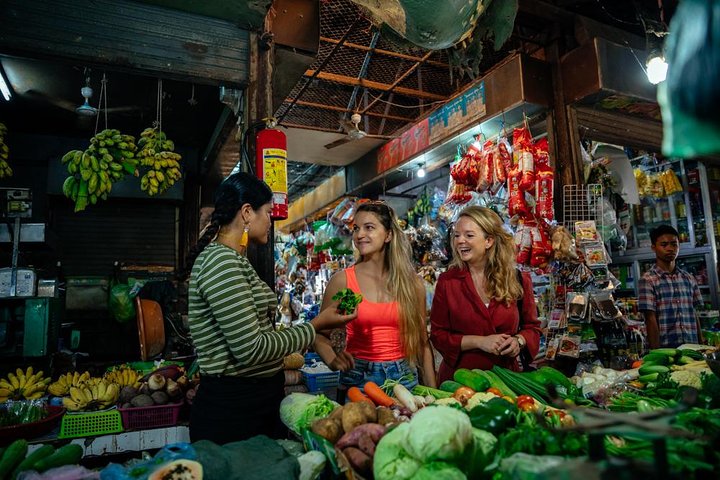
Khmer cooking classes teach you amok, lok lak, and the flavours of Cambodian cuisine, starting with a market visit and ending with the meal you prepared.
Format
Bike tours cycle the flat, shaded roads of the temple circuit — the small circuit covers 17 kilometres through Angkor Wat, Bayon, and Ta Prohm. E-bikes recommended for the heat.
Private tours — the standard and recommended format in Siem Reap. A dedicated guide and tuk-tuk driver, customised itinerary, and remarkably affordable pricing ($30–60 USD per day for guide + tuk-tuk).
Multi-day tours extend beyond the one-day circuit — two days minimum, three days recommended. The three-day Angkor Pass ($62 USD) is the best value.
Browse the full selection below and book the Angkor experience that fits your time — whether that is a single sunrise at the moat, a three-day deep dive into the Khmer civilisation, or the floating villages and countryside that surround it.